What Is the Difference Between Arts and Craft Style and Shaker
Our art is the work of a modest minority equanimous of educated persons, fully conscious of their aim of producing beauty, and distinguished from the great torso of workmen by that aim. ~William Morris
Arts & Crafts is not Craftsman
Arts and crafts is not Craftsman; it predates Craftsman way by 80 years and began on the other side of the Atlantic. The defoliation of American Craftsman manner with Arts & Crafts is a common misunderstanding because they have the same roots in William Morris. Morris, father of the Arts & Crafts movement, died in 1896 then missed the usual turn-of-the-century engagement referenced for the Arts & Crafts move.

Bluish and White William Morris Poppy Tiles, installed in Kelmscott House study fireplace, London
Morris preferred a simpler, more honest style by Victorian standards; he wanted to elevate the decorative arts to the level of fine fine art. Gustave Stickley designed and sold mass-produced house plans in his catalog, Craftsman Homes, also as his own mass-produced piece of furniture -- hence Craftsman-mode.
Craftsman Style
Early American Arts and crafts homes, however, were more Morris in their philosophy and these are as well called Craftsman, more in keeping with the medieval roots of the German word kraft than the early 20th century mass-produced mode. The similarities are the use of natural materials and motifs.
While Morris was an inspiration to Stickley and many who came after, it's difficult to conceive him as beingness a Stickley fan. Arts and crafts is a philosophy. Craftsman is a style. Morris applied that philosophy to Ruby-red House, the offset Arts & Crafts domicile, full of medieval inspirations.
The medieval undertones of Arts & Crafts abound at Kelmscott, Morris's concluding and most love home. Kelmscott Manor is Tudor, merely and so identified with Morris, and then full of Morris & Co. and Arts and Crafts furnishings, that its proper noun evokes Pre-Raphaelite Arts & Crafts ethics and the values the underlie Arts & Crafts decorative arts.
Whatever home tin comprise Arts & Crafts -- Morris would like that. But non every home tin exist chosen Craftsman.
The Arts & Crafts Philosophy
Arts and crafts has been called the Decorative Arts wings of the Pre-Raphaelite movement.
At the heart of Arts & Crafts, is a philosophy, and a reactionary one at that: To elevate the decorative arts to the level of art, and to brand them personal and accessible.
When William Morris (the Soul of Arts & Crafts) built Ruddy House, his first married home, it became a gathering place for a circle of Pre-Raphaelite artists, Burne-Jones, Rossetti, and others. Red House was designed by William Morris in collaboration with his friend, builder Philip Webb.
Arts & Crafts Tiles
William Morris Designs and Overview
William De Morgan Designs and Overview
Morris Gallery and Catalog
Tiles from Fabric Designs
William De Morgan Gallery and Catalog

From Medieval to Arts & Crafts
Red Business firm, was the only house commissioned by William Morris and the kickoff independent architectural piece of work of his close friend and collaborator, Philip Webb. William and Jane moved to Red Business firm when Morris was 26, and Jane a mere xix. Inspired by a summer tour of the cathedrals of northern France with his friend, Edward Burne-Jones, Morris built Red House, and indeed the Arts & Crafts Movement, inspired past medieval values of adroitness that elevated decorative arts. At that time, Morris had fairly recently come into his inheritance and little expense was spared.
Reddish Business firm was built forth the path that Chaucer'due south pilgrims would have traveled, and this theme was carried through much of its pattern. It became a identify where classical medieval images and themes abounded. The Morrises lived at Ruby House for five years from 1860-65. Both daughter, Jenny and May, were built-in at Red House. Morris and his Pre-Raphaelite friends spent much of their free time decorating and furnishing Blood-red Firm, designing the medieval garden. 
I of the first Arts & Crafts pieces: The William Morris St. George chiffonier 1861-1862 - designed past his friend Philip Webb and painted past Morris himself and his friends, Dante Gabriel Rossetti and Edward Burne-Jones for Red House, Morris's first married domicile.
Tile Galleries
Crimson House and Early Tiles
Bestiaries, Celestials, Maps, and Monsters
Book of Hours, Herbals, Codices, and Crowns
Bestiary: Dragons, Unicorns, Unusual Pets
Medieval Codices, Gardens and Herbals
Morris & Co.

Conceived with friends after a dinner at Red House, 'The Firm' (Morris, Marshall, and Faulkner) later dissolved, and Morris & Co. was built-in. 'The Firm' offerings included tile, article of furniture, embroideries, stained glass, created by Morris's Pre-Raphaelite friends and their friends and families.
Pre-Raphaelite ceramics master, William De Morgan, began his career in stained drinking glass at Morris & Co. but his interests and gift lay in ceramics. After working with Mrrosi for several years, he was inspired establish his ain tileworks, where he continued to produce decorative ceramics for Morris and others. His work came to define Arts & Crafts ceramics. His later work especially show a stylized chemical element characteristic of Art Nouveau.

William De Morgan peacock fireplace tiles

William Morris Brother Rabbit Kitchen

Arts & Crafts Tile Galleries
William De Morgan Tiles
William Morris and Edward Burne-Jones Fairy Tale Fireplace Tiles
Glasgow School Arts & Crafts
Morris and Morris & Co. Tiles
Arts and crafts Tile Catalogs
William Morris and English Arts & Crafts to Art Nouveau
Afterward Arts & Crafts
Arts & Crafts: A Family Tree with Many Branches
Alas, these terms are used interchangeably, sometimes cartoon boundaries where there are none, and at others blurring differences. We have:
-
English Arts and Crafts - the simplified, naturalistic, medieval-inspired William Morris philosophy and mode. A simple, well-nigh ascetic, style by Victorian standards.
-
American Arts and Crafts - a term that embraces both East Coast traditional Arts and crafts and the clean lines of Roycroft Arts & Crafts style of Elbert Hubbard's community of artisans and craftsman, as well as many Mediterranean-influence California Arts and Crafts dwelling house and buildings
-
Stickley Craftsman Manner - An early 20th century style, popularized by Gustav Stickley with mass produced architectural plans and furniture advertised in his magazine-catalog, The Craftsman
-
Mission Style - Some other proper noun for Craftsman style in the Southwest -- a Stickley Craftsman furtniture salesman told a newspaper reporter that the table in his catalog could be seen "in a Castilian Mission in Southern California." The newspaper printed it every bit Mission way and the proper name stuck.
-
California Arts and Crafts - Nothing mass-produced nigh these. Retrieve Greene & Greene and Gamble Business firm. Yet likewise chosen Craftsman.
My Arts & Crafts tiles are wonderful, of course, merely they draw from the work of William Morris and a larger circle from English Arts & Crafts to early Art Nouveau: William De Morgan, Charles Rennie Mackintosh, Walter Crane. I also have some fin-de-siècle California Arts and Crafts botanicals based on those commissioned of A.R. Valentien by Ellen Browning Scripps. For subsequently Amerian Arts & Crafts and Craftsman tiles, you might like:
Duquella Tile
Pratt & Larson Craftsman tiles (These work well as field tile with my tiles
Tile Restoration Center
Frank Lloyd Wright tiles at Motawi Tileworks

William De Morgan Western farsi Fish Frieze
Afterwards Arts and Crafts and Fine art Nouveau
The Arts & Crafts design philosophy underpins Arts and Crafts, Craftsman, and, to a bottom extent, Fine art Nouveau / Jugenstil. The tiles of William De Morgan, who began his career in the decorative arts working for William Morris, work well in both Victorian and Arts and Crafts homes. De Morgan beginning worked in stained glass at Morris, Marshall, Faulkner and Co. before his interests shifted to pottery.
Yous would think that his early designs would reflect more Victorian tastes and his after, more stylized designs, with Art Nouveau and American Arts and crafts -- However, early designs evolved and I find myself having to examine the glaze and color to confirm the De Morgan "menstruum", rather than the style of the blueprint. (meet William Morris and William De Morgan Tulip and Trellis to compare the styles. Both were implemented by De Morgan, simply Morris'south influence is clearer in the earlier version).
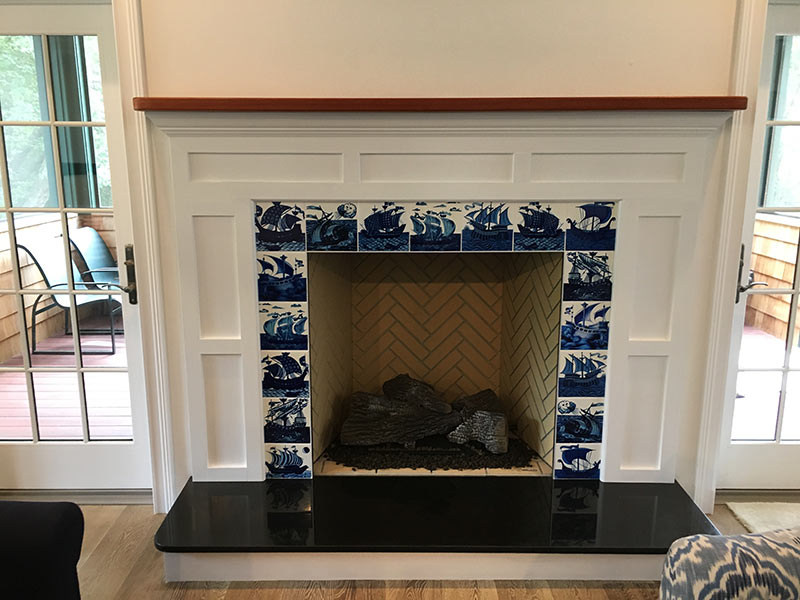
William De Morgan Ships and Galleons Fireplace
Later De Morgan tiles fit in with American Arts & Crafts, Craftsman, and Art Nouveau styles. Tiles based on Glasgow Arts & Crafts principal, Charles Rennie Mackintosh or Cincinnati ceramics chief turned California botanical creative person, AR Valentien, are at dwelling in Arts & Crafts, Art Nouveau, and California Arts & Crafts or Craftsman homes.
De Morgan's Early on Fine art Nouveau Style
These tiles show De Morgan moving abroad from Morris's symmetical and natural forms to a more than asymmetric and stylized form:
Fantastic Creatures a la Art Nouveau
Winged Seahorse panel
Fulham Ducks
Peacock and Salamander fireplace panels
Art Nouveau
Art Nouveau grew out of the mid-century Pre-Raphaelite Arts & Crafts movement and took hold in the 1890s, at a time when Morris's artist attentions had shifted to Kelmscott Press. (see the Kelmscott Chaucer tiles.)

Walter Crane Tiles: Flora's Train
Walter Crane and William Morris: Bloom Tiles
De Morgan Happy Dragons
Persian Garden of Fantastic Birds
Scottish Arts and Crafts Tiles
Inspired by Morris and his Pre-Raphaelite friends, the Arts & Crafts move in Scotland in the belatedly 1880s was centered in Glasgow. Like Morris, they worked across media, working in needlework, metal, carvings, and more. Glasgow schoolhouse influences fused Celtic Revival, Arts & Crafts, and continental influences that came to define Fine art Nouveau.

Jessie Thousand. King Garden Tiles
Margaret Macdonald 'Four Queens' Art Nouveau tiles
Jessie M. King Mermaid Backsplash
Charles Rennie Mackintosh Flowers
Jessie 1000. Rex Frog Prince
Hannah Moore Walton Pre-Raphaelite Painted Tile
California Arts & Crafts
Every bit we've already seen, not all American Arts & Crafts are Craftsman. This is especially truthful in California. California Arts & Crafts style is more than in keeping with the medieval tradition of kraft that was beloved by Morris and the Pre-Raphaelites. The Gamble House in Pasadena, California, the Roycroft furnishings that still exist, and the Rockwood pottery of AR Valentien exemplify the Arts & Crafts philosophy. None of these were ever mass-produced.
Relief Tiles

Many of the original California Arts & Crafts homes had carved relief tiles. Morris and De Morgan made a few such as the lions shown, but it is more feature of the California manner. I exercise not have whatever Morris or De Morgan relief tiles, just if you take an idea in mind for a relief tile, contact Steve Moon, my neighbour, beyond the river at Tile Restoration Center. If he can't go far for you, he tin probably betoken you in the right management.
California Craft Tiles
California Trees and Wildflowers, A.R. Valentien
Source: https://williammorristile.com/arts-and-crafts-tiles.html
0 Response to "What Is the Difference Between Arts and Craft Style and Shaker"
Postar um comentário